
Friday, February 10, 2017


Monday, September 12, 2016

Chicago Pastoral Memorial Service on October 7-9, 2016 was streamed live.
You may access the event recording here: Chicago Gathering October 7-9 2016
Monday, March 7, 2016
A Voluntary Activity To People Outside The Truth.
Laymen’s Home Missionary Movement— Is It An
Organization?
Question (1920)—Are you not forming an
organization of the Laymen’s Home Missionary
Movement?
Answer.—We are not forming an organization of
any kind; for the Laymen’s Home Missionary
Movement is not an organization; it is a movement, a
voluntary activity in which the Lord’s people
cooperate in service to people outside the Truth. If it
were an organization, it would have the essential
parts of an organization, which are (1) a character or
constitution, either in writing or by verbal agreement;
(2) expressed or implied tests as qualification for
membership and for officers; (3) members who have
the right to vote and elect officers; (4) a Board or
Committee of control; (5) executive officers; (6) bylaws,
either in writing or by verbal agreement. The
Laymen’s Home Missionary Movement has none of
these things; therefore it is not an organization. Our
well known opposition to organizations having the
work of the Priesthood in charge should have kept
back the questioner from suspecting that we are
forming an organization. The only organization with
which we desire to be identified is the one that the
Lord, not man, formed—the Body of Christ, fully
organized for its members in a voluntary and orderly
manner to fellowship with one another in the study,
spread and practice of the Truth. The dear brethren
of God’s Priesthood who are working in the Laymen’s
Home Missionary Movement do fellowship in the
study, spread and practice of the Truth as now due;
but in no manner are they banded together by the
machinery of a human organization. Therefore the
Laymen’s Home Missionary Movement is not an
organization. It is a movement, an activity.
PT. 1920 Pg. 197
Organization?
Question (1920)—Are you not forming an
organization of the Laymen’s Home Missionary
Movement?
Answer.—We are not forming an organization of
any kind; for the Laymen’s Home Missionary
Movement is not an organization; it is a movement, a
voluntary activity in which the Lord’s people
cooperate in service to people outside the Truth. If it
were an organization, it would have the essential
parts of an organization, which are (1) a character or
constitution, either in writing or by verbal agreement;
(2) expressed or implied tests as qualification for
membership and for officers; (3) members who have
the right to vote and elect officers; (4) a Board or
Committee of control; (5) executive officers; (6) bylaws,
either in writing or by verbal agreement. The
Laymen’s Home Missionary Movement has none of
these things; therefore it is not an organization. Our
well known opposition to organizations having the
work of the Priesthood in charge should have kept
back the questioner from suspecting that we are
forming an organization. The only organization with
which we desire to be identified is the one that the
Lord, not man, formed—the Body of Christ, fully
organized for its members in a voluntary and orderly
manner to fellowship with one another in the study,
spread and practice of the Truth. The dear brethren
of God’s Priesthood who are working in the Laymen’s
Home Missionary Movement do fellowship in the
study, spread and practice of the Truth as now due;
but in no manner are they banded together by the
machinery of a human organization. Therefore the
Laymen’s Home Missionary Movement is not an
organization. It is a movement, an activity.
PT. 1920 Pg. 197
Monday, February 15, 2016

Wednesday, February 10, 2016

Friday, January 15, 2016

Thursday, December 10, 2015
Present Truth Winter 2015 - "Only God Appoints His People's Leaders" unless...
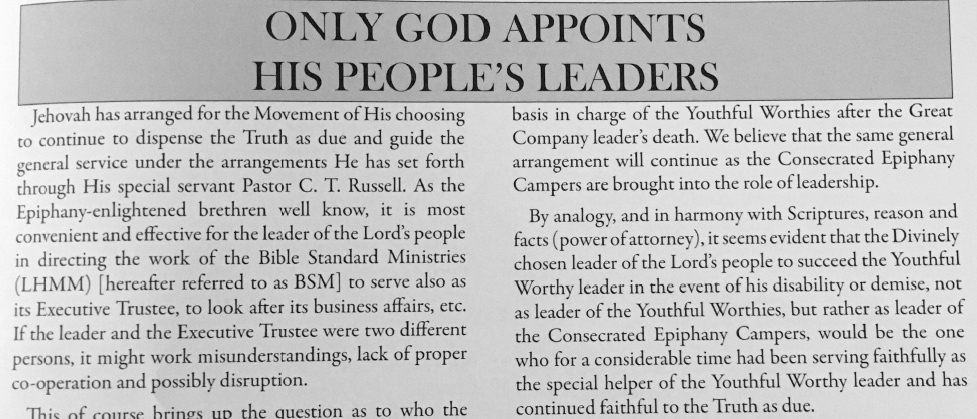
Unless you self appoint yourself, and make it appear that it's God's will.

Wednesday, September 30, 2015

Monday, August 24, 2015
Back to the Basics - Pastor Russell Laid the Foundation
Tentative Justification Precedes Sanctification
We have observed that tentative justification is not merely a mental assent to the fact that Christ died as man's Redeemer and that certain blessings of reconciliation to God were thus secured for the race, but that, additionally, in order to become a justified believer a certain amount of consecration is implied. Such justification implies a recognition that sin is exceedingly sinful (Rom. 7: 13), and a desire to cease from it—to be free from its power as well as free from its penalties—a desire, therefore, to be righteous in harmony with the righteous Creator and in accord with all of the laws of righteousness. It implies, moreover, that the believer has set his mind, his will, to follow righteousness in all of life's affairs. Faith in Jesus, accompanied by such consecration, gives tentative justification, but does not imply sacrifice. God has a right to demand that all of his creatures shall approve righteousness and hate iniquity, or else consider themselves aliens from him—his enemies. But God does not demand that we shall sacrifice our lives in his service, nor for any other cause. Sacrifice, therefore, is set forth in the Scriptures as a voluntary act—not demanded by the law, even though it be, as the Apostle declares, a "reasonable service," and he urges us—"I beseech you therefore, brethren, by the mercies of God, that ye present your bodies a living sacrifice, holy, acceptable to God, your reasonable service." Rom. 12: 1 With some, a consecration to sacrifice may follow very soon after faith in the Lord and the desire to walk in his ways of righteousness have been reached; but it must follow, it cannot precede, because, as we have already seen, we must be at least tentatively justified by faith before we could have any dealings with God whatever, or enjoy fellowship in any sense with him. With others, this justified condition is attained and followed some time before any thought of a complete consecration, or sacrifice of earthly interests to the Lord and to his cause is even contemplated. But, under present conditions, those who start to walk the path of justification, the path of righteousness, the path of harmony with God, will not go very far along this path before they encounter opposition, either from within or from the world or from the Adversary.
P6 Pages 151-152
The former representative from Germany, and the acting executive trustee of the LHMM might want study this matter, then offer an apology to the Brethren for teaching error. The same error Rutherford taught!
We have observed that tentative justification is not merely a mental assent to the fact that Christ died as man's Redeemer and that certain blessings of reconciliation to God were thus secured for the race, but that, additionally, in order to become a justified believer a certain amount of consecration is implied. Such justification implies a recognition that sin is exceedingly sinful (Rom. 7: 13), and a desire to cease from it—to be free from its power as well as free from its penalties—a desire, therefore, to be righteous in harmony with the righteous Creator and in accord with all of the laws of righteousness. It implies, moreover, that the believer has set his mind, his will, to follow righteousness in all of life's affairs. Faith in Jesus, accompanied by such consecration, gives tentative justification, but does not imply sacrifice. God has a right to demand that all of his creatures shall approve righteousness and hate iniquity, or else consider themselves aliens from him—his enemies. But God does not demand that we shall sacrifice our lives in his service, nor for any other cause. Sacrifice, therefore, is set forth in the Scriptures as a voluntary act—not demanded by the law, even though it be, as the Apostle declares, a "reasonable service," and he urges us—"I beseech you therefore, brethren, by the mercies of God, that ye present your bodies a living sacrifice, holy, acceptable to God, your reasonable service." Rom. 12: 1 With some, a consecration to sacrifice may follow very soon after faith in the Lord and the desire to walk in his ways of righteousness have been reached; but it must follow, it cannot precede, because, as we have already seen, we must be at least tentatively justified by faith before we could have any dealings with God whatever, or enjoy fellowship in any sense with him. With others, this justified condition is attained and followed some time before any thought of a complete consecration, or sacrifice of earthly interests to the Lord and to his cause is even contemplated. But, under present conditions, those who start to walk the path of justification, the path of righteousness, the path of harmony with God, will not go very far along this path before they encounter opposition, either from within or from the world or from the Adversary.
P6 Pages 151-152
The former representative from Germany, and the acting executive trustee of the LHMM might want study this matter, then offer an apology to the Brethren for teaching error. The same error Rutherford taught!
Sunday, August 9, 2015
...and omit quoting from other places what gives another thought...
One of the objectionable things in the writings of J.F. Rutherford and F.H. McGee is that they quote from some places in Brother Russell's writings what they think favors their view, and omit quoting from other places what gives another thought, and thus fail to do justice to "that Servant." Our method in dealing with the various expressions of "that Servant" when they appear contradictory is to seek to harmonize them whenever possible, as we would apparent Scriptural contradictions; and whenever such a harmonization is impossible, we seek to follow that expression of his opinion that seems most reasonable and most in harmony with the fulfilled facts. Let us not forget that Brother Russell repeatedly corrected his own interpretations, when fulfilled events proved that he did not clearly understand and teach them before they were fulfilled…
E Vol 3. Pages 81-82
E Vol 3. Pages 81-82
Sunday, June 28, 2015
Permanent Marker Series: E10, Page 286

"Their humility, as well as Bro. Russell’s teachings (Mordecai charged her, v. 10), prevented their claiming for themselves Little Flockship (not shewed her people), nor even Spirit-begettal (kindred), for as yet neither of these things were certain, hence could be held only as a matter of faith, not of knowledge, since from 1881 1878 onward these things were not certain in individual cases, because all consecrators were not accepted into the high calling. "
If Youthful Worthies existed from 1878 to 1881, then this date of certainty needs to be 1878!
Sunday, May 24, 2015
Permanent Marker Series: E10, Page 284
"Bro. Russell nourished (brought up [literally, nourished], v.7) Youthful Worthies (Hadassah [myrtle], Neh. 8:15) who later became New Creatures (Esther [star]) after the new-creaturely nominal-church leaders (uncle's), who had brought them to consecration, as their symbolic father, were as antitypical Saul rejected and the nominal church, as their symbolic mother, as the Lord's mouthpiece was rejected (she had neither father nor mother). After leaving the nominal church as Youthful Worthies, from 1878 onward, and coming into the Truth, these were as a class taken by Bro. Russell as a symbolic daughter."
This reference was once used by the LHMM to show that Youthful Worthies existed in 1878. But, the only way for that to work is to remove the second dependent clause in the above sentence. Taking out "and coming into the Truth" eliminates the time needed for them to come into the Truth and full consecration. That date is 1881, shown only two pages later in the same volume. We covered this reference years ago. Please see:
Saturday, April 11, 2015
Non-Spirit-Begotten Apostles Partaking
NON-SPIRIT-BEGOTTEN APOSTLES PARTAKING
Another consideration helps us to see that the Spirit-enlightened, non-Spirit-begotten consecrated ones should partake of the Memorial—the fact that the Apostles partook of the first Lord's Supper with Jesus while consecrated but not yet Spirit-begotten (though they did have the holy Spirit in a lesser sense—John 20: 22). They could not be Spirit-begotten until the outpouring of the Spirit at Pentecost. Before Pentecost their condition was very much the same as that of "Those Consecrating Between the Ages'' today, though they had the prospect of Spirit-begettal at Pentecost and membership in Christ's Body, which no longer is available here after 1914, in the Time of Trouble (Rev. 7: 1-3; Isa. 66: 7; Amos 9: 13; see PT 515 …
P.T. 1984 Pg. 23
Another consideration helps us to see that the Spirit-enlightened, non-Spirit-begotten consecrated ones should partake of the Memorial—the fact that the Apostles partook of the first Lord's Supper with Jesus while consecrated but not yet Spirit-begotten (though they did have the holy Spirit in a lesser sense—John 20: 22). They could not be Spirit-begotten until the outpouring of the Spirit at Pentecost. Before Pentecost their condition was very much the same as that of "Those Consecrating Between the Ages'' today, though they had the prospect of Spirit-begettal at Pentecost and membership in Christ's Body, which no longer is available here after 1914, in the Time of Trouble (Rev. 7: 1-3; Isa. 66: 7; Amos 9: 13; see PT 515 …
P.T. 1984 Pg. 23
Saturday, March 28, 2015
Truth Is Stranger Than Fiction

Was Bro. Markiewicz in agreement with the two messengers, and leader of the Great Company before the former executive trustee changed the Quasi-Elect article in the Present Truth?
Sunday, February 22, 2015
Permanent Marker Series: E10, P. 250
We needed to add more text to a paragraph in E10, page 250 so that the former Executive Trustee's view can be applied. We say former Executive Trustee because, apparently, there is a new one...even though he was never voted in for that position. Interesting.
Thursday, February 5, 2015

Sunday, February 1, 2015

Wednesday, January 28, 2015

Thursday, January 22, 2015

Wednesday, January 21, 2015
Bible Standard Ministries/LHMM Sectarianism and Clericalism Reaches India
Another one of Leon Snyder's unnecessary letters reaches India.

Subscribe to:
Posts (Atom)