Wednesday, February 23, 2011
Antitypical Court PT. 1964 Page 55
(11) The antitypical Court will eventually consist of three classes: the Ancient Worthies, developed before the Gospel Age, and the Great Company and the Youthful Worthies, the two classes that as such are developed here in the Epiphany period, beginning in the Fall of 1914, which two classes therefore constitute the Epiphany Court (see, e.g., E 5, p. 420; P '40, pp. 13, 14; '59, pp. 34-36). Jesus as God's Executive has been in the process of building the Epiphany Court from 1914 onward, in His calling and development of the Youthful Worthy class and in His dealing with the Great Company as a class, in readying them for the Marriage Supper. The Epiphany Court was completely set up individually and tentatively by Sept. 16, 1954, the end. of the antitypical 80 days of Lev. 12 (P '55, p. 29; '59, p. 37),...


Wednesday, February 16, 2011
Further Light
 "(29) In the Parousia reaping period (1874-1914), in the Epiphany, or Apocalypse, period in its restricted, 40-year sense (1914-1954) and ever since 1954 in its wider sense, in the lapping beginning of the Basileia (Kingdom) period, many have blessed others with the Parousia Truth, the Parousia and Epiphany Truth or whatever measure of Truth they have inside or outside of Babylon, at least sufficient to enable them to bring others into tentative justification. In these periods, these servants of God have, by the measure of such Truth as they possessed, figuratively fathered many who by repentance and faith in Jesus as Savior have become tentatively justified, and who make full consecrations in the post-Sept. 16, 1954 Epiphany period and so become Consecrated Epiphany Campers. By causing others through the Word to become tentatively justified, these servants have figuratively fathered such into partial consecrations, consecrations to righteousness (comp. F 124, 125). These consecrations are not to be confused with full consecrations, which in the Gospel-Age proper made full consecrators into Spirit-begotten new creatures and which since 1881 additionally have made many others into Spirit-enlightened, non-Spirit-begotten fully consecrated ones." PT. 1977 Pages. 90-91
Wednesday, February 9, 2011
This Thought Published At Least Seven Times
 Especially for the benefit of new readers, we will repeat here one of the clear, at least seven-times-published enumerations of the classes in the Epiphany Camp in its present, unfinished state: "As in the unfinished Epiphany Court, as it existed from 1914 to 1954, there were three classes—(1) the Great Company, a Spirit-begotten class, (2) the Youthful Worthies, a consecrated and Spirit-enlightened but not Spirit-begotten class, and (3) the unconsecrated tentatively justified—so in the unfinished Epiphany Camp, as it exists from [Oct.] 1954 onward, there are three classes—(1) the Consecrated Epiphany Campers, a consecrated and Spirit-enlightened but not Spirit-begotten class, a non-Levite class [but typed by the Nethinim, who were the appointed assistants to the Levites—Ezra 8: 17, 20; 2; 7: 7, 24; Neh. 3: 26, 31; 7; 10: 28; 11: 3, 21; P '71, pp. 37-42; '72, pp. 12-15, 75; '73, pp. 29, 30; '78, p. 55], (2) the unconsecrated tentatively justified and (3) the unjustified, nominal people of God" (P '75, p. 13; comp. P '63, pp. 77, 78).
Wednesday, February 2, 2011
Reserved List III

E4. Page 420
Of course, after the last crown was assigned there could be no more vacancies; and hence all on the reserved list as well as all future consecrators had no other Kingdom class position open for their entry than that reserved for the Youthful Worthies.
(19) Question: Should we now encourage believers to consecrate, with Youthful Worthies' prospects as their hope?
Answer: We should now encourage believers to consecrate, because consecration is always in order. We should, however, not now encourage any one to consecrate in hope of the High Calling.
Wednesday, January 26, 2011
Reserved List II

E4. Page. 420
Apparently the Lord made between 1881 and 1914 a reserved list of those consecrators for whom there were no crowns available at the time of their consecration; and when a vacancy occurred, He selected the most available one on the reserved list for that vacancy. Doubtless the Lord considered at least three things in deciding the availability of the candidates: (1) their spirit of faithfulness, (2) their talents for that particular place in the Body for which there was a crown vacant, and (3) their providential situation.
The current Executive Trustee's "present view" is exposed as an error. Reserved List? If there was a class of Youthful Worthies in 1878 or 1881, what was the purpose of having them on a "Reserved List?"
See Reserved List III. Coming soon...
Wednesday, January 19, 2011
Reserved List I

E4 Page. 419
(18) Question: Is it correct to say that some who consecrated after 1881 and before 1914 were put into the Youthful Worthies class, because there were no vacancies at the time in the Little Flock, and that subsequently some of them were received by Spirit-begettal into the High Calling to fill vacancies there, while others remained among and are now of the Youthful Worthies class?
Answer: Yes
Taking the question out of the present perfect and with some creative mental gymnastics one might be able to twist the meaning to infer there was a separate and distinct class for the Youthful Worthies in 1881. In the next sentence, Bro. Johnson dispels this notion and explains why this can't be so. See "Reserve List II" coming soon.
Wednesday, January 12, 2011
Permanent Marker Series: E4, Page 469

(Click the above image for best quality.)
Well, here we are. We've reached the end of E4. Page 469 offers us the strongest reference contradicting the Executive Trustee's view that Youthful Worthies existed from 1878-81. Bro. Johnson tells us that between Pentecost and 1881, ALL the consecrated were New Creatures. We have no choice but to use the last bit of our purple marker to move that date back to 1878. Who knew that the Executive Trustee's error would need so many markers, ink and changes to E4.
Thursday, January 6, 2011
Permanent Marker Series: E4, Page 463

(Click the above image for best quality.)
Page 463 has part of the answer to the question posed on page 462 about the Youthful Worthies seeing spiritual things. Just like that page, any reference to 1881 on this page needs to be changed to 1878 in order to help the Executive Trustee. Otherwise, his new Youthful Worthies from 1878-81 don't have that ability and that makes no sense at all.
Thursday, December 30, 2010
From Brother Johnson Regarding Canticles

E11, page 692: The following are the divisions of this book: 1: 1—2: 7 treats of the Church's experiences during the Jewish Harvest; 2: 8-17 treats of certain Parousia experiences of the Church; 3: 1-11 treats of the Church's experiences during the Dark Ages (1) and then from 1691 to 1914; 4: 1—5: 1 treats of the Parousia experiences of the Church doctrinally and ethically; 5: 2—6: 3 treats of the foolish virgins in the nominal church during the Parousia and Epiphany; 6: 4—8: 14 treats of the Epiphany Church in herself, in her contacts with Jesus and in her contacts with the Great Company and the Youthful Worthies, and incidentally of certain things as to the Great Company and the Youthful Worthies...
E11, pages 714-715: The Church individually declares that she has a fellow class of young consecrators (a little sister, 8), i.e., the Youthful Worthies. When in the Parousia mention was made of these, no Old Testament nor New Testament passages (hath no breasts) were quoted to prove their existence, which was then inferred from the fact that the close of the general call was followed by more consecrators than there were available crowns, and from the attitude of the Divine attributes toward the faith classes. But there came in the Epiphany, at whose start in 1914 the door of entrance into the high calling closed for new aspirants (Luke 13: 24-27), the time when it was due that this class begin to come to the front, be recognized as such and as such be sought for by figurative suitors...
Bro. Johnson correctly treats the Epiphany Church in her contacts with the Youthful Worthies starting in 1914 when the Epiphany began. Bro. Johnson makes it crystal clear the Youthful Worthies begin to come to the front in 1914 as a separate and distinct class.
Thursday, December 23, 2010
When Shiloh Comes, P2 Pages 86-87

Now bear in mind the date already found for the beginning of these Gentile Times, B.C. 606, while we proceed to examine the evidence proving their length to be 2520 years, ending A.D. 1914."
The Executive Trustee's "present view" overshadows the true work of our Lord during the Parousia and its 40 year harvest from 1874-1914.
Thursday, December 16, 2010
Permanent Marker Series: E4, Page 462

(Click the above image for best quality.)
Page 462 is one of the most interesting in E4 when considering the Executive Trustee's "present view" idea. If we don't change the four instances of 1881 to 1878 and modify the "general call" reference, his new 1878-81 Youthful Worthies cannot see the hidden mystery. It doesn't make any sense that they would not have this ability.
How is it possible that Bro. Johnson didn't include them in being able to see spiritual things? Maybe it is because they didn't exist during this time.
How is it possible that Bro. Johnson didn't include them in being able to see spiritual things? Maybe it is because they didn't exist during this time.
Wednesday, December 8, 2010
Permanent Marker Series: E4, Page 443

(Click the above image for best quality.)
Page 443 is much like some of the other pages we've recently modified. Any reference to 1881 needs to be changed to 1878 if we are to accept the Executive Trustee's belief that the Youthful Worthies began in that year. His Youthful Worthies must be included in this answer because they should be available to fill any future potential vacancies in the Little Flock (see E4, page 420) and therefore their status is unsure.
Wednesday, December 1, 2010
Coming out of Babylon
PT. 1971, Pg. 38: (9) In the larger antitype, set forth in par. (7), the highest class of God's people that came out of Babylon is the Royal Priesthood, the Little Flock. All of this class were reaped and gleaned by the Harvest Truth message and came out from 1878 to 1916 (John 9: 4; Rev. 7: 1-4; 6: 9-11; Isa. 66: 7; Amos 9: 13, etc.; E 5, pp. 143-165; C, Appendix, pp. 387-404). Also, many crown-losers came out, though not then known as such individually or as a class (E 4, pp. 215, par. 1, 246, bot., 250, par. 1, 466; E 5, p. 174). In the antitype, in the finished picture the Priests (crown-retainers) alone are represented in the Holy; and as Divine beings they are represented in the Most Holy (in the type, only the priests served in the Holy and Most Holy of the temple). The next class among those to leave Babylon consists of antitypical Levites. (Many antitypical Levites have remained in Babylon and therefore are not noted in this picture.) From 1878 to 1914, the antitypical Levites who left Babylon were unconsecrated tentatively justified ones and also some consecrated ones for whom no openings to be of the Little Flock were available (though not then known as individuals or as a class). In the Epiphany from 1914 to 1954, the antitypical Levites who left Babylon were of (a) the unconsecrated tentatively justified; (b) the subordinate Gospel-Age Spirit-begotten class—the Great Company—who were formerly in the Holy as prospective Priests; (c) the consecrated, Spirit-enlightened elect class for whom no crowns were available, and who therefore were not Spirit-begotten—the Youthful Worthies. But in the post-1954 setting (P '59, pp. 36-38), only classes (b) and (c) are antitypical Levites, in the Court. (In the type, only the Levites—in addition to the priests, whom they specially assisted—served in the court; but the Levites were not permitted to enter the Holy or Most Holy.) The Great Company in its three groups—Kohathites, Merarites and Gershonites—is represented in the inner, or higher, court of the temple, with its three rows of stones; and the Youthful Worthies in their similar three groups are represented in the outer court, with its three rows of stones (1 Kings 7: 12; P '68, p. 71).
From the same year PT. 1971, Pages 76-77 helps clarify the above: We agree that it is through the Truth that God calls to consecration. In fact, everyone who up to 1878 (when the fullness of the Gentiles came in) made a full consecration was by that Truth begotten of the Spirit, as called to the High Calling. But between 1881 and 1914 only certain ones were through the Truth by God, usually quite some time after the Truth induced them to consecrate, begotten unto the High Calling; and the other consecrators, though induced by the Truth to consecrate, were not Spirit-begotten, and hence were not initiated into the High Calling; and since Oct. 1914, the Truth induces many to consecrate but begets none to the High Calling.
From the same year PT. 1971, Pages 76-77 helps clarify the above: We agree that it is through the Truth that God calls to consecration. In fact, everyone who up to 1878 (when the fullness of the Gentiles came in) made a full consecration was by that Truth begotten of the Spirit, as called to the High Calling. But between 1881 and 1914 only certain ones were through the Truth by God, usually quite some time after the Truth induced them to consecrate, begotten unto the High Calling; and the other consecrators, though induced by the Truth to consecrate, were not Spirit-begotten, and hence were not initiated into the High Calling; and since Oct. 1914, the Truth induces many to consecrate but begets none to the High Calling.
Wednesday, November 24, 2010
Permanent Marker Series: E4, Page 440

(Click the above image for best quality.)
Page 440 is a continuation of the answer started on 439, so we have to be consistent and change both instances of 1881 to 1878. Had we not changed the second instance of 1881 to 1878, then the Executive Trustee's new Youthful Worthies would not have knowledge of the deep things. That cannot be right.
Thursday, November 18, 2010
Permanent Marker Series: E4, Page 439

(Click the above image for best quality.)
Page 439 is another one that needs repair in order to match the beliefs of the Executive Trustee. If there were Youthful Worthies from 1878 to 1881, then they should have been included in this answer because they were not begotten of the Spirit. They would be a part of that majority. A more precise change could be:
"While we know that all of those who consecrated between 1878-81 and the majority of those who consecrated between 1881 and 1914 were not begotten of the Spirit . . ."
"While we know that all of those who consecrated between 1878-81 and the majority of those who consecrated between 1881 and 1914 were not begotten of the Spirit . . ."
Thursday, November 11, 2010
The Fuller Truth on the Consecrated
 (10) The fuller truth on the consecrated, Spirit-enlightened but not Spirit-begotten elect class, developed here in the end of the Age after the closing of the door of entrance into the High Calling, was not yet due to be given in Bro. Russell's day. Nevertheless, the Lord did privilege him to point out this class—which we call the Youthful Worthies—as one that would eventually be rewarded with the Ancient Worthies (see, e.g., F 156, 157; Question Book, pp. 151, 152, 154, 156-158; Z 4836; 5761, col. 2 [in par. 2 he refers to them as a class]; comp. E 4, pp. 317-469).
--PT. 1971 Pg. 38
Thursday, November 4, 2010
Permanent Marker Series: E4, Page 438

(Click the above image for best quality.)
If the Youthful Worthies were called starting in 1878 and they became a class in 1881, as the Executive Trustee believes, then it seems strange Bro. Johnson wrote that all consecrators before Sept. 16, 1914 were to be accepted as priests. Why were no indications due until then if a separate call was already in effect during the harvest? We don't know, so we chose to point out this oddity on the page to make it fit better with the "present view."
Thursday, October 28, 2010
Permanent Marker Series: E4, Page 437
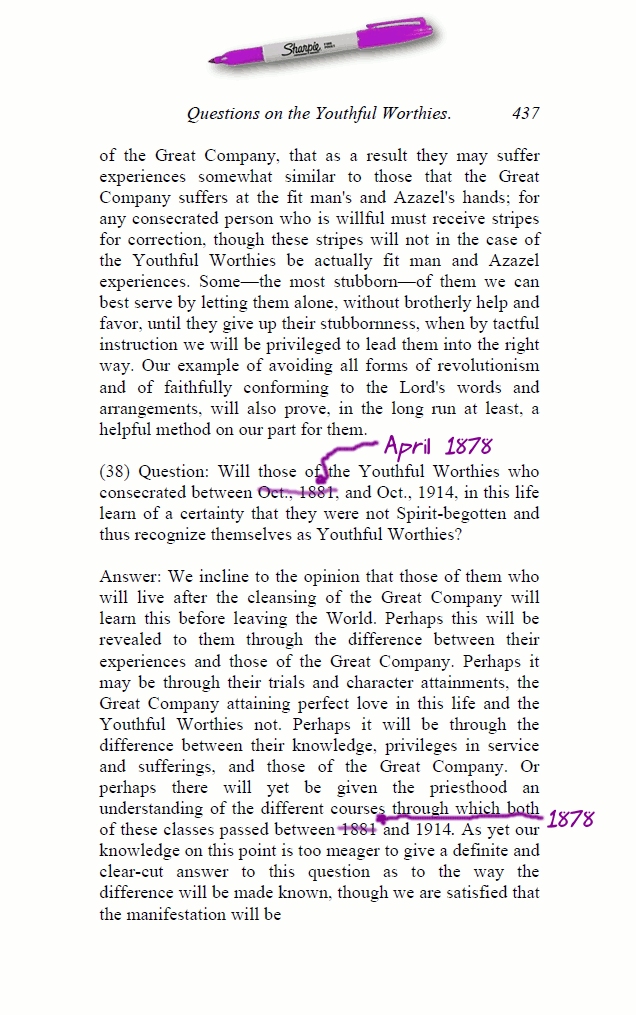
(Click the above image for best quality.)
This page is problematic for the Executive Trustee. It says nothing about Youthful Worthies consecrating between 1878 and 1881. If everyone at the time thought they were running for the high calling, then we need to move the 1881 date back to 1878 so that the Executive Trustee's new consecrators can have the opportunity to learn that they were not Spirit-begotten.
Interestingly, if the Executive Trustee wanted to misread the starting date of another class, he could take the part where Bro. Johnson says, "through which both of these classes," to mean that the Great Company also began as a class in 1881 and that Bro. Johnson somehow had two views on their existence.
Interestingly, if the Executive Trustee wanted to misread the starting date of another class, he could take the part where Bro. Johnson says, "through which both of these classes," to mean that the Great Company also began as a class in 1881 and that Bro. Johnson somehow had two views on their existence.
Friday, October 22, 2010
PT 1976, Page 21
In all siftings Satan is the real, behind-the-scenes sifter—the one who originates, initiates and carries on persistently the sifting activity (Luke 22: 31; 1 Pet. 5: 8). He uses as his visible agents those who are the most suitable to his purposes and who succumb to his temptations, who are pliable in his hand and do not sufficiently resist him to hinder his use of them in pertinent respects (James 4: 7; Eph. 4: 27).
Ever since Bro. Russell passed beyond the veil, in 1916, Satan has used a variety of methods in his efforts to ensnare God's Parousia-enlightened people. For example, he appealed convincingly to some of these brethren to reject the post-1916 Truth, by claiming that after 1916 there was to be little or no advancing Truth—that the door of entrance into the High Calling was not closed in the Fall of 1914 but remained open, that the Epiphany, or Apocalypse, as a period did not then begin, that no Youthful Worthy class was being developed (including post-1914 consecrators), etc...
Friday, October 15, 2010
A Consistent Message
 PT 1984, Pg. 23: The Apostle Paul's words in 1 Cor. 2: 9-16 denying that the non-Spirit-begotten are able to understand "the deep things of God" are limited to the time the general call to the High Calling was open, during which time to be Spirit-begotten and to be consecrated meant the same thing, and so all the consecrated were then Spirit-begotten, which was not the case before the call to the High Calling opened. So after the general call ceased, Paul's pertinent words do not apply universally. But the rule that applies always is that only the consecrated can see the due Truth. Therefore, "Those Consecrating Between the Ages" do have the due Truth on the deep things as a witness of their being friends and servants and prospective sons of God.
Subscribe to:
Posts (Atom)